
Save the Whales
Your Support is important
Sign Our Petition!
Download Whale Ship Strikes Dossier 2024
Whale – Safe Award 2022
Through meticulous scrutiny of internal environmental reports & policies, direct engagement with relevant Sustainability associates, and exhaustive inspection of all available information online, Friend of the Sea selected the most actively involved companies in the shipping and cruise line industries and has awarded them with the highest level of Whale-Safe recognition for their displayed engagement towards the conservation of endangered whales.
Top Shipping Lines: Hapag-Lloyd
The WSO has selected Hapag-Lloyd for the Friend of the Sea / WHALE-SAFE Award 2022 – Shipping Lines, owing to its commitment to reducing whale ship strikes.
Top Cruise Lines: MSC Cruises
The WSO has selected MSC Cruises for the Friend of the Sea / WHALE-SAFE Award 2022 – Cruise Lines, owing to its commitment to reducing whale ship strikes.
Dolphin and Whale Watching Organizations
The WSO has identified numerous dolphin and whale watching organizations who have displayed an outstanding level of practice and commitment during excursions towards preventing whale ship strikes, awarding them the Friend of the Sea / WHALE-SAFE Award 2022.
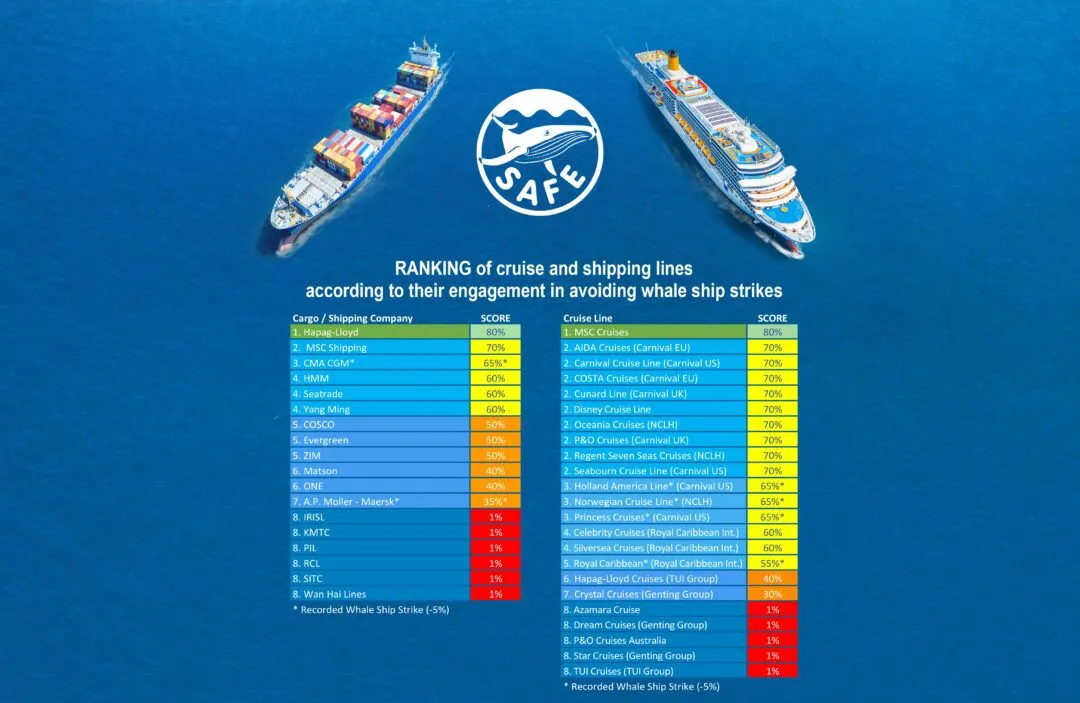
2021/2022 Ranking of cruise and shipping line’s whale safe practices
Collisions between marine mammals and ships, referred to as “ship strikes,” pose a significant threat to whale populations. Despite effective preventative measures such as observation systems and adherence to slow down regulations, major shipping and cruise liners have yet to fully implement them. In an effort to encourage adoption, Friend of the Sea conducted a comprehensive study to evaluate the engagement of major cruise and shipping lines in addressing ship strikes.
Save The Whale
Data was gathered from companies’ websites, Sustainability reports, scholarly articles, and direct communication with stakeholders. Companies were assessed based on their compliance with slowdown regulations, initiatives to reduce noise pollution, onboard observation programs, and reporting of ship strikes. Additional points were awarded for documented instances of whale strikes.
Whale Ship Strike
The assessment included twenty of the largest shipping and cruise line operators globally and serves as an open-source reference for other companies interested in participating. Despite evidence linking cruising speed with reduced ship strikes, few assessed companies have implemented speed controls in high-risk areas where shipping routes intersect with endangered whale habitats. While half of the companies demonstrate some level of engagement, the remaining entities show little to no concern regarding the issue.
Companies interested to participate in the ranking or are interested in providing updates on their policies should proceed to get in contact at: info@friendofthesea.org
The problem
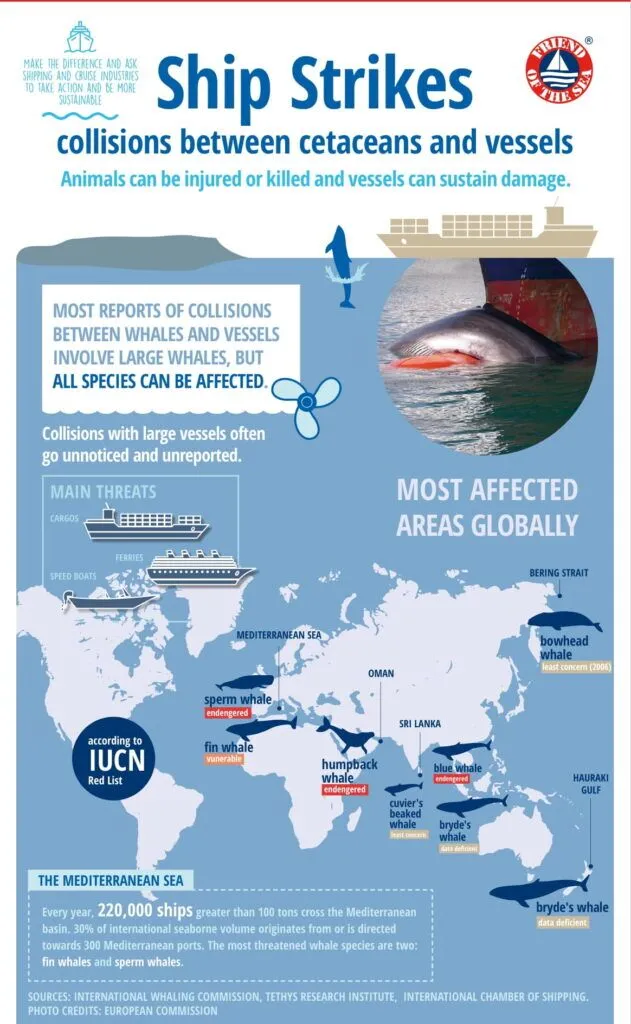
Until recently, the main threats to marine mammal populations were believed to be whaling and unintentional bycatch. However, recent studies have identified ship strikes, collisions between marine mammals and ships, as a primary threat. This phenomenon, often referred to as the “silent massacre,” is largely unnoticed and undocumented, leading to neglect of the issue. With studies primarily relying on beached whales to estimate strike numbers, the severity of the issue is likely underestimated, as only around 10% of deceased whales wash ashore.
Watch Our Video on Save the Whales!
Enviromental consequences
The shipping industry’s exponential growth, doubling in size every 10 years, significantly increases the lethal impact on whales. Experts estimate that cargo, cruise, and fishing vessels collide and kill at least 20,000 whales annually. Fatal collisions in the Mediterranean Sea and Sri Lanka have nearly doubled over the past four decades, halving whale populations.
Seven of the thirteen large whale species are classified as endangered, with ongoing ship collisions threatening to push some species to extinction. Additionally, preserving whale populations could play a crucial role in mitigating the climate crisis. Whales act as keystone species and regulate marine ecosystems globally, while also serving as powerful carbon sequestering agents. When a whale dies, approximately 33 tons of CO2 are removed from the atmosphere and stored in the ocean depths for thousands of years, equivalent to what a tree would absorb over 1600 years. Each whale has a lifetime sequestering value estimated at $2 million, with the global population valued at $1 trillion.
Possible solutions
As the threat of great whale extinction looms, immediate and collective action is imperative. Friend of the Sea has launched an awareness campaign to highlight the neglected issue and hold major shipping lines accountable for their environmental damage.
Friend of the Sea has introduced a certification standard urging ship owners and governments to adopt measures to prevent whale ship strikes. These measures include thermal cameras, online reporting systems, and minor shifts in shipping lanes. Entities complying with these measures will display the Friend of the Sea WHALE-SAFE logo.
How you can help
Support the Save the Whales campaign by signing the Change.org petition. Your support will encourage shipping and cruise line operators to prioritise marine mammal conservation.
Together, we can prevent the extinction of these magnificent creatures.